
Everyday Survival: A Field Guide to Life’s Hard Bits
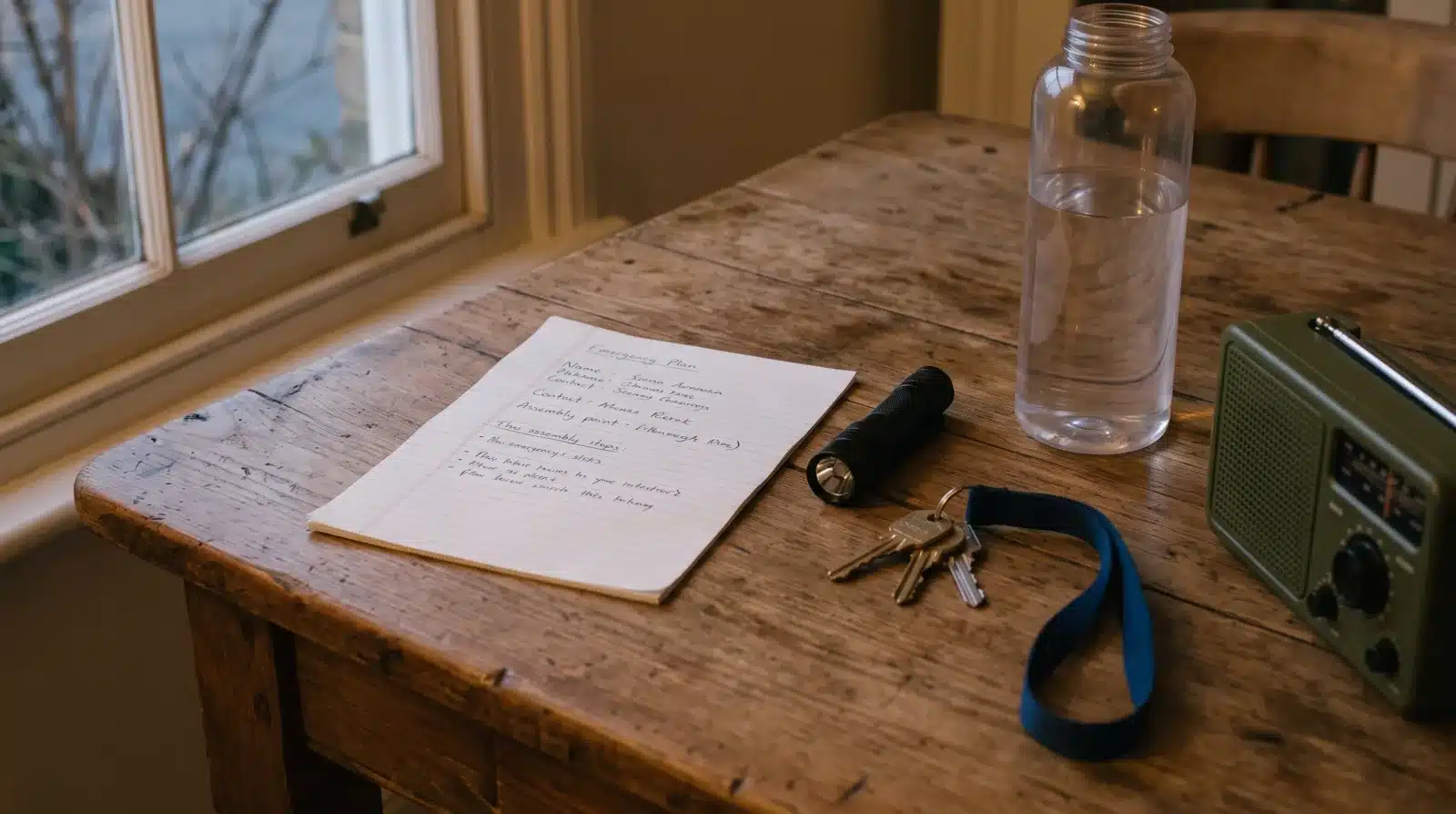
Ask someone to picture survival and they will picture wilderness. A person alone, a fire that will not catch, water that has to be found before dark.
Almost nobody survives anything like that. What people actually survive is a Tuesday. A results envelope. A phone call from a hospital. Three days without power in a heatwave with a toddler and a fridge full of food going off. An interview where the first question is one they had not thought to prepare.
These are not lesser events. They are the real distribution of hard things in a normal life, and the striking part is how similar they are underneath. A bushfire and a job interview have almost nothing in common on the surface. Underneath, they are the same problem: something is happening that you have not been trained for, the clock is running, and the quality of your outcome will be set mostly by decisions you either made in advance or did not.
This guide is the spine of the site. It sets out the four moves that work on every hard thing, the failure modes that recur no matter the scale, and the small number of preparations that pay off across all of them. Every other article here is one of these moves applied to one specific situation.
The emergency numbers in this guide are Australian. If you are somewhere else, call your own country’s emergency number instead — 911 in the United States and Canada, 999 in the United Kingdom, 112 across Europe and on most mobile phones worldwide. The advice itself applies wherever you are.
The 10-minute version
If you read nothing else:
- Decide in advance, in writing, with a number. Not “we’ll see how it goes” — “if it hits X, we do Y.” Pre-commitment is the single highest-value survival habit at every scale, from evacuating a house to walking out of a study session.
- Get the physical layer sorted first. Water, sleep, medication, money, transport, a charged phone. Emotional and strategic problems are much easier to solve than they look once the physical layer is not also failing.
- Act while your options are still cheap. Almost every bad outcome in this guide is caused by the same thing: waiting for more certainty, and paying for the delay with your options.
Why “survival” is the right word for ordinary life
The preparedness industry is worth tens of billions and growing at roughly 9% a year, on its way past US$140 billion by 2028. Around 6% of adults describe themselves as preppers. Less than half of households own any emergency supplies at all, and only about 39% have any kind of plan.
Read those numbers together and you find something odd. An enormous industry serves a very small group intensely, while the majority owns nothing, plans nothing, and does not see itself in any of the content. Not because those people are careless. Because the genre is wearing a costume they do not recognise — camouflage, ammunition counts, societal collapse — and they have correctly concluded it is not addressed to them.
Meanwhile those same people are getting through genuinely hard things constantly, and doing it without a method. They handle the redundancy, the newborn, the diagnosis, the exam block, the flood that came through the garage. They just do it in the dark, inventing the response as it happens, and paying the cost of every decision they did not make earlier.
That gap is the entire idea here. Survival is not a hobby or an identity. It is a general competence: the ability to keep functioning and making decent decisions while under load. It applies to a cyclone and to your first performance review, and the skill genuinely transfers. Learning to think clearly under a deadline you cannot move makes you better at both.
The four moves
Every hard situation, at any scale, is handled with the same four moves in the same order. Orient, triage, act, recover. The moves do not change. Only the content does.
1. Orient: work out what is actually happening
Before doing anything, establish what is true. This sounds obvious, and it is the step people skip hardest, because acting feels productive and looking feels passive.
Orienting is three questions:
- What do I actually know, as distinct from what I fear? Write both down separately. The fear list is usually longer and the knowledge list is usually more useful.
- What is the clock? How long until this becomes irreversible? An interview has a hard clock. A slow leak in a relationship has no clock at all, which is exactly why it goes unaddressed for years.
- Who already knows what to do? Almost every situation in this guide has someone whose entire job is that situation: the SES, a triage nurse, a financial counsellor, the university’s special-consideration officer, the Fair Work Ombudsman. The single most common expensive mistake is treating a well-documented problem as a private one.
The reason to orient first is that panic is largely a symptom of missing information. Not always — but often enough that the fastest way to stop feeling out of control is to reduce the number of unknowns by two or three.
2. Triage: sort by what is irreversible
Now sort. Not by what is urgent, and definitely not by what is emotionally loudest. Sort by reversibility.
Three buckets:
Irreversible. Injury, death, a missed legal deadline, a signature, a sent message, a burnt bridge, a lost tenancy record. These get all your attention first, even when they feel less pressing than the noise.
Expensive but fixable. Money, property, marks, reputation, most of what a bad week does to you. Real costs, worth minimising — but not worth trading against anything in bucket one.
Loud but harmless. The bulk of it. The mess, the awkwardness, the embarrassment, the missed social thing, the unanswered messages piling up. This bucket screams the loudest and matters the least, and it eats capacity that the first bucket needs.
Sorting by reversibility is what lets you drop things without guilt. During the six weeks after a baby is born, the house being a wreck is bucket three. A parent falling asleep holding the baby on a couch because nobody scheduled a sleep shift is bucket one. Those two facts are not competing for your attention. One of them just sounds like it is.
3. Act: use pre-committed decisions, not real-time judgement
Here is the finding that ties the whole site together, and it comes from the most studied disaster in Australian history.
On Black Saturday in 2009, 173 people died — Australia’s worst bushfire loss of life. When the fatalities were mapped, 113 people had died inside houses, 27 outside, 16 in or near cars. That was a shift from earlier fires, where most deaths happened outdoors defending property or leaving too late. The Royal Commission’s conclusion about the “leave early” policy is worth reading closely: leaving early, before there is a fire, is the safest option, and staying to defend a well-prepared home is a reasonable choice in less severe fires for people mentally and physically able to do it. The problem was that most people did neither. They had not properly prepared to stay, and they had not left.
They were, overwhelmingly, waiting. Waiting for more information, for the wind to shift, for someone to tell them it was time. And the option to leave safely closed while they waited.
That is the same failure that produces most bad outcomes in ordinary life, and it looks identical every time. You do not decide to fail the subject; you delay the withdrawal form past the census date. You do not decide to blow up your finances; you avoid opening the bill until it becomes a default. You do not decide to end the marriage; you keep not raising the thing that is bothering you until it has calcified.
The fix is mechanical, and this is why fire agencies push it so hard: decide in advance, tie the decision to an observable trigger, and write it down. Australia’s fire danger ratings run Moderate, High, Extreme, Catastrophic, and the advice at Catastrophic is not “assess your situation” — it is leave, and leave the night before or early that morning. The rating is doing the deciding, in a state of mind you will not have on the day.
You can build the same structure for anything:
| Situation | The trigger | The pre-committed decision |
|---|---|---|
| Bushfire risk | Rating hits Extreme | Car packed, go-bag in boot, plan is now active |
| Bushfire risk | Rating hits Catastrophic | Leave the night before. No reassessment |
| Study | Two hours past your cut-off time | Stop. Sleep is now worth more marks than revision |
| Interview | Question you cannot answer | Say so in one sentence, then say what you would do to find out |
| Bill you cannot pay | The day you know you cannot pay it | Call and ask for hardship terms. Before the due date, not after |
| Sick child at 2am | Any of the specific red flags on your list | Go now. Do not wait for morning to “see how they are” |
| Argument | You notice you are flooded and stop hearing them | Twenty-minute break, stated out loud, with a time to resume |
None of these are clever. That is the point. A decision made in advance is available to you when your judgement is degraded, and your judgement will be degraded exactly when you need it. That is not a character flaw. It is what stress does to cognition, and planning around it is the whole skill.
4. Recover: treat the aftermath as part of the event
The last move is the one that gets skipped almost universally, because by the time you reach it the emergency is over and nobody feels like doing admin.
Recovery is where the lasting damage is either prevented or locked in. Damage after a flood is a two-day race against mould, not a leisurely cleanup. Insurance claims are won or lost by whether photographs were taken before anything was moved. The value of a hard week at work is either captured in a document you can point at in six months, or lost. The lesson from a fight is either extracted in the calm conversation two days later, or it is not learned and you will have the same fight again in March.
The recovery habit is a single question, asked once, in writing, within a week: what would I want in place if this happened again? Then do the smallest version of that thing immediately. Not the ideal version. The small one, today, while the memory is still doing the motivating.
What actually goes wrong
Across every scale of hard thing, the same five failures do most of the damage.
1. Waiting for certainty that is not coming. Covered above, and it is comfortably number one. The information you are waiting for usually arrives after the decision point has passed. Set the trigger, then act on the trigger rather than on your feelings about the trigger.
2. Solving the loud problem instead of the irreversible one. The mess, the awkward conversation, the appearance of coping. Bucket three dressed up as bucket one.
3. Letting the physical layer fail while treating the problem as psychological. People try to think their way through a crisis while sleeping five hours, eating badly, dehydrated, and off their medication schedule. Teenagers need 8 to 10 hours of sleep, and fewer than two in ten actually get it — and the consequences show up as attention, mood and learning problems, which then get diagnosed as motivation or attitude. Fix water, sleep and food first. A surprising amount of what looked like a mindset problem simply leaves.
4. Treating a documented problem as a private one. There is a specialist, a hardship program, a legal provision, a hotline or a form for nearly every situation on this site, and most people find it two weeks after it would have helped. Look for the institution before you look for willpower.
5. Never rehearsing. A plan that has never been run is a guess. Households with a written emergency plan sit around 39%, and the share who have ever walked through it is far smaller. The first time you test a plan you find something broken — the go-bag has expired medication, nobody knows the meeting point, the torch batteries are dead, the document scans are on a laptop that is inside the house you just left.
The Australian reality box
Local specifics, because generic advice is where content goes to die.
- Fire danger ratings: Moderate, High, Extreme, Catastrophic. At Catastrophic the official advice is to leave bushfire risk areas — go the night before or early in the morning.
- Emergency numbers: 000 for fire, police and ambulance. 132 500 for SES — flood, storm and storm damage. 1800 022 222 for healthdirect nurse triage, which is the right call for most 2am “is this an emergency?” questions outside Victoria (Victorians: Nurse-on-Call, 1300 60 60 24).
- When the network drops, a text often gets through when a call will not, and an out-of-area contact is more reachable than a local one. Keep a battery radio: ABC Local Radio is the designated emergency broadcaster.
- Money problems have legal machinery. Utilities must offer hardship programs. The National Debt Helpline (1800 007 007) is free and independent. Insurance disputes escalate to internal dispute resolution and then AFCA at no cost.
- Work problems have a regulator. The Fair Work Ombudsman publishes notice periods and redundancy entitlements, so you do not have to take an employer’s word for the numbers.
- Water: plan on 3 litres per person per day for drinking, and at least three days’ worth. For a family of four, that is 36 litres — about six 6-litre bottles, roughly one supermarket shop, done once.
The three-tier version of everything
Every recommendation on this site is costed three ways, because the standard advice — buy a kit — is useless to someone with $0 spare, and insulting to someone who already has one.
| Tier | Spend | What it buys you |
|---|---|---|
| Free | $0, one hour | A written plan, a decision trigger for the hazard you actually face, a photographed record of your possessions, document scans in cloud storage, and everyone in the house knowing the meeting point |
| Solid | ~$50–150 | Nine litres of water per person, a torch, a battery radio, a power bank, a basic first aid kit, two weeks of shelf-stable food, and a printed contact list |
| Comfortable | ~$200–500 | The above plus a proper first aid kit, water storage with rotation, a camp stove, spare medication, and a way to charge devices for several days |
The free tier is the one that matters most, and it is the one almost nobody does. Writing down what you will do, and when, costs nothing and is worth more than any object you can buy.
The drill: an hour this weekend
Reading this changes nothing. Running it changes something. One hour, once:
- Ten minutes — pick your hazard. Not all of them. The one your address actually faces: fire, flood, cyclone, heat, or extended blackout. Look it up on your state emergency service site rather than guessing.
- Ten minutes — write two triggers. One “get ready” and one “act now”, each tied to something observable rather than a feeling. Put them on the fridge.
- Ten minutes — one page of contacts and meeting points. On paper. Your phone will be dead, missing, or in the house you just left.
- Fifteen minutes — photograph every room, open every cupboard, film the roll. Insurance claims are decided by evidence collected before anything happens. Send it to cloud storage.
- Ten minutes — scan the document set. Licence, passport, insurance policies, prescriptions, birth certificates, the lease or title. Encrypted cloud folder, plus a USB in whatever bag you would grab.
- Five minutes — say it out loud to whoever lives with you. The plan that exists only in one person’s head is not a plan. It is a secret.
If you have children, run the same hour again as a game rather than a lecture. Fear does not make anyone safer. Knowing where to meet does.
Where to go from here
Pick the one that is actually in front of you.
- Facing exams: How to Survive Year 12 Exams
- First interview: How to Survive Your First Job Interview
- Newly married: How to Survive Your First Year of Marriage
- Live somewhere that burns, floods or blacks out: Australian Disaster Preparedness: The Complete Guide
- Own nothing and want the fastest possible start: The Two-Hour Preparedness Sprint
Frequently asked questions
Is calling exams and job interviews “survival” a bit much?
The word is doing real work here. Survival describes performing under load with incomplete information and a clock — which is exactly what an exam block or an interview is. It is not a claim that an exam is as dangerous as a fire. It is a claim that the method is the same, and that people who have a method do better than people improvising.
What is the single highest-value thing to do first?
Write two triggers for the hazard you actually face and put them where you will see them. Ten minutes, no money, and it fixes the failure that causes most bad outcomes — deciding too late.
How much should preparedness cost?
The most valuable tier costs nothing. Beyond that, $50–150 covers water, light, radio, power and first aid for most households. If you are being sold a four-figure kit before you own a written plan, the order is wrong.
Does any of this help with anxiety, or does thinking about disasters make it worse?
Specificity helps; vagueness does not. A vague sense that something could go wrong has nowhere to land. A written plan converts that into a finite, finished task. If preparing is making you feel worse rather than better, that is worth raising with a GP or calling Beyond Blue on 1300 22 4636 — and it is a legitimate reason to stop reading and go outside.
Is there a version of this for a household with no money and no time?
Yes, and it is the first hour of the drill above. A plan, two triggers, a contacts page and photos of your possessions. Everything in that list is free.
This article is general information, researched from the sources listed below and not reviewed by a professional in the relevant field. Check the sources, and get advice or training suited to your situation. Read our full disclaimer.
Sources
- Marketing Scoop — the preparedness industry’s growth
- TruePrepper — prepping statistics and demographics
- Reality Studies — how many people are preppers
- 2009 Victorian Bushfires Royal Commission findings, via Black Saturday research summaries
- Surviving bushfire: the role of shelters and sheltering practices during the Black Saturday bushfires
- AFAC — Australian Fire Danger Rating System
- CFA — about fire danger ratings
- American Academy of Sleep Medicine — teen sleep duration advisory
- National Sleep Foundation — teens and sleep
- Mission Australia Youth Survey 2025
- Australian Red Cross — RediPlan preparedness guide